The liquid batcher should be operated at ambient temperature from plus 10 ° C to plus 40 ° C, relative humidity from 45 to 80%, atmospheric pressure from 84 to 107 kPa (from 630 to 800 mm of mercury), in the conditions temperate and tropical climates, 2nd and 3rd accommodation categories.
At protection of the centrifugal pump against direct influence of solar radiation and atmospheric precipitations for a temperate climate – the 1st category of placement in accordance with GOST 15150.
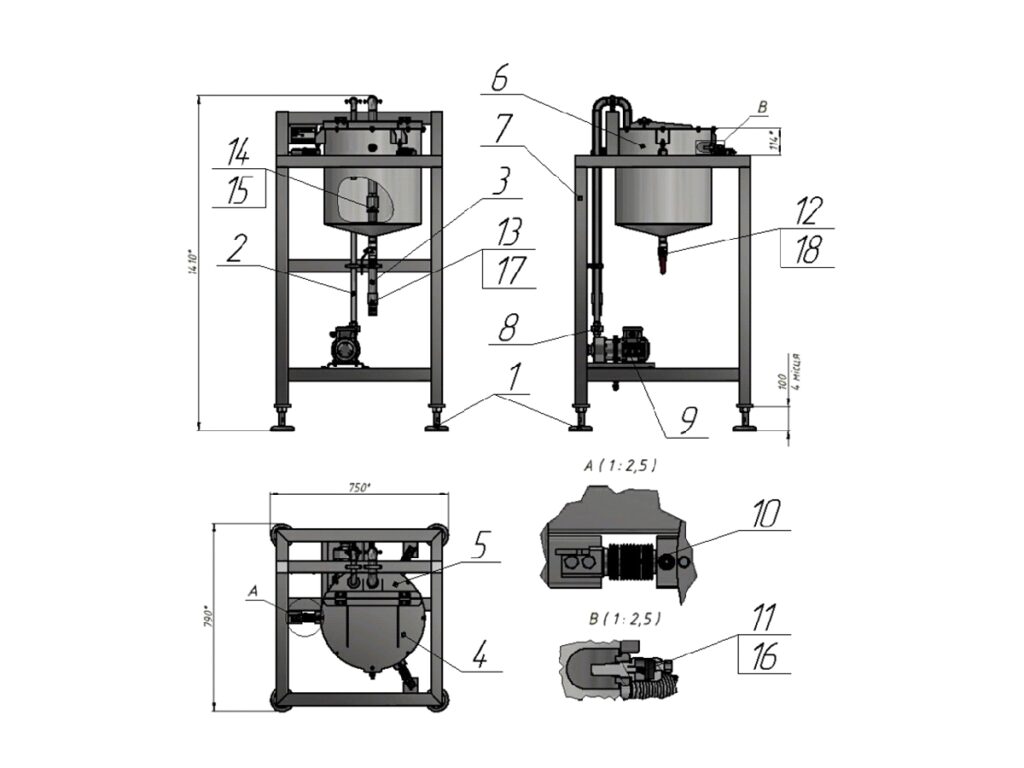
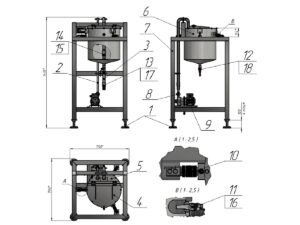
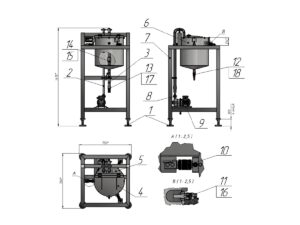
Composition of the dispenser:
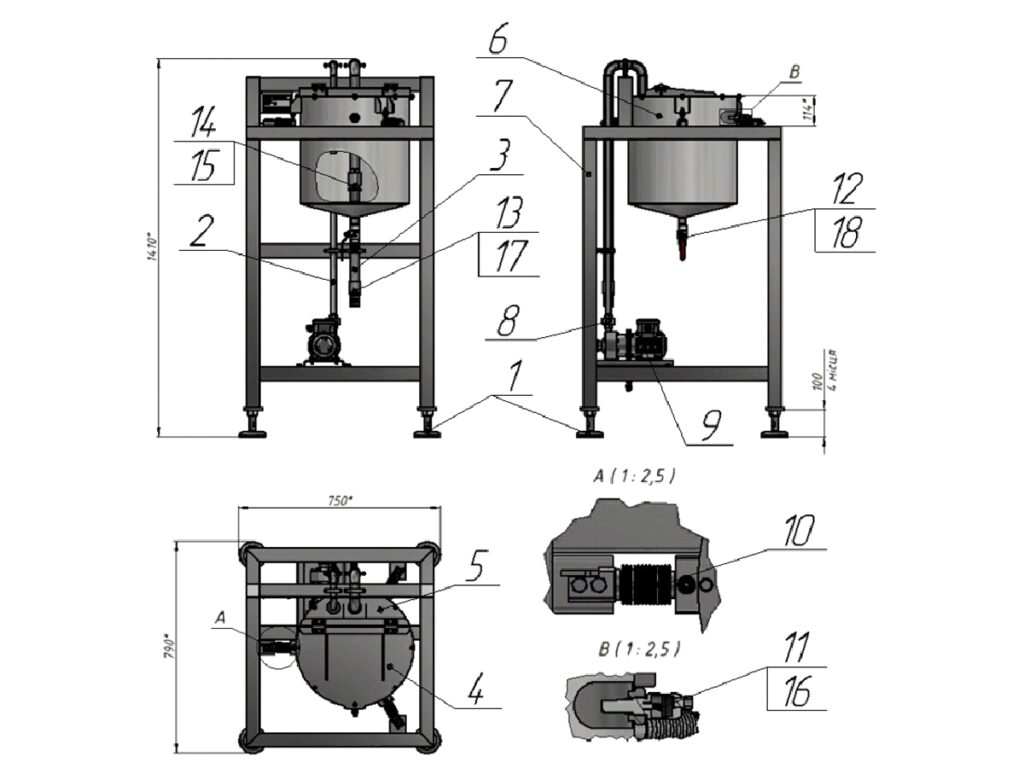
1 – Support
2 – Jellied pipe
3 – Suction pipe
4 – Cover
5 – The cover is stationary
6 – Reservoir
7 – Frame under the tank
8 – American G1 / 2 BB AISI 304
9 – Centrifugal pump CM MAG-P4 PP 3.4 m3 / h
10 – The sensor is tensometric VM-11-C3 – 20 kg – IP68
11 – Capacitive level sensor
12 – Ball valve G3 / 4 AISI 304
13 – Straight coupling G1, Du 25 AISI 304
14 – Check valve G1, Du 25 AISI 304
15 – Strainer G1, Du 25 AISI 304
16 – The sealing washer 18х22х2 DIN 7603
17 – Fitting AISI 304 G1x25mm
18 – AISI 304 G3 / 4x20mm fitting
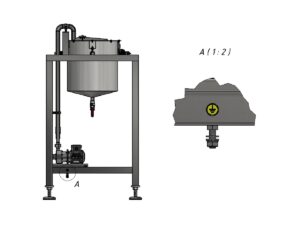
The liquid dispenser is a frame 7 (which is regulated by supports 1) on which, through strain gauges 10, the tank 6 is fixed.
The tank is closed with a fixed lid 5 and a lid 4, in addition to monitor the liquid level is a capacitive sensor 11, which is sealed with a washer 16.
To drain the liquid from the tank, in its lower part there is a ball valve 12 and a fitting 18.
The tank is filled due to the centrifugal pump 9 to which the American 8 and the filling pipe 2 are attached.
On the suction pipe 3, in the tank, a non-return valve 14 and a strainer 15 are installed, a straight coupling 13 and a fitting 17 are fixed on the side of the frame.
SEQUENCE OF OPERATION
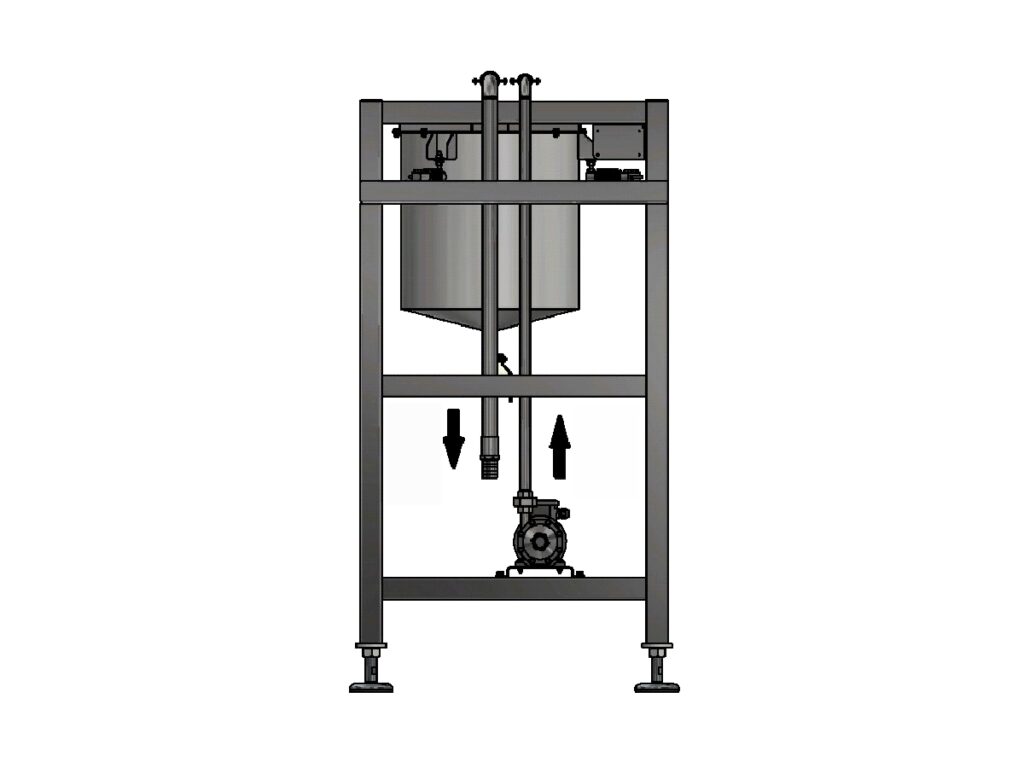
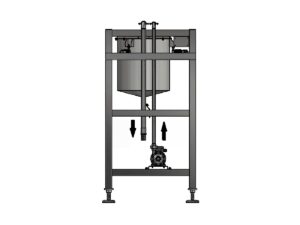
A nozzle with liquid is connected to the centrifugal pump, which is fed to the tank through the filling pipe.
With the help of strain gauges (which are adjusted and calibrated to the appropriate weight), the amount of liquid supplied is dosed, the capacitive sensor (which is also calibrated) – prevents the overflow of liquid in the tank.
To the suction pipe, through a union the branch pipe with the second centrifugal pump which takes liquid from the tank joins.
The strain gauges are activated, transmit the pulse to the centrifugal pump and supply a new portion of liquid to the tank, the process is cyclical.
At the end of the suction pipe is a non-return valve – which prevents the return of liquid to the tank and a strainer – which cleans the liquid.